This guide contains affiliate links. If you buy through them, I may earn a commission at no extra cost to you. Learn more
In this guide
If you want a gentler heat, lower running costs, and the easiest installation, an infrared sauna is usually the better fit for a home. If you want very hot air, steam from water on the stones, and the classic Finnish experience, choose a traditional sauna. Infrared saunas run at about 120 to 150°F; traditional saunas run at about 150 to 195°F and need more power, more ventilation, and usually a 240V circuit.
Both are good choices. They’re just different tools. This guide compares them the way you’d compare any home project: the experience, the space, the power, the cost to buy, and the cost to run.
The quick comparison
| Infrared sauna | Traditional sauna | |
|---|---|---|
| How it heats | Infrared panels warm your body directly | A heater warms the air and stones |
| Typical temperature | About 120 to 150°F | About 150 to 195°F |
| Humidity | Low (dry) | Dry, with steam bursts when you pour water on stones |
| Warm-up time | About 10 to 20 minutes | About 20 to 45 minutes |
| Typical heater power | About 1,200 to 3,000 watts | About 4,000 to 9,000 watts |
| Electrical | 120V or 240V depending on size | Almost always a dedicated 240V circuit |
| Ventilation | Small built-in vents | Planned intake and exhaust vents |
| Typical prefab price | About $1,500 to $8,000 | About $3,000 to $8,000 |
| Best for | Daily use, gentle heat, easy installs | Hot, steamy, social sessions |
Temperature and wattage ranges come from manufacturer and installer guides, including Peak Saunas’ NEC guide and Sun Home’s 120V vs 240V guide. Prices are typical 2026 ranges from SaunaPlace.
How each one heats you
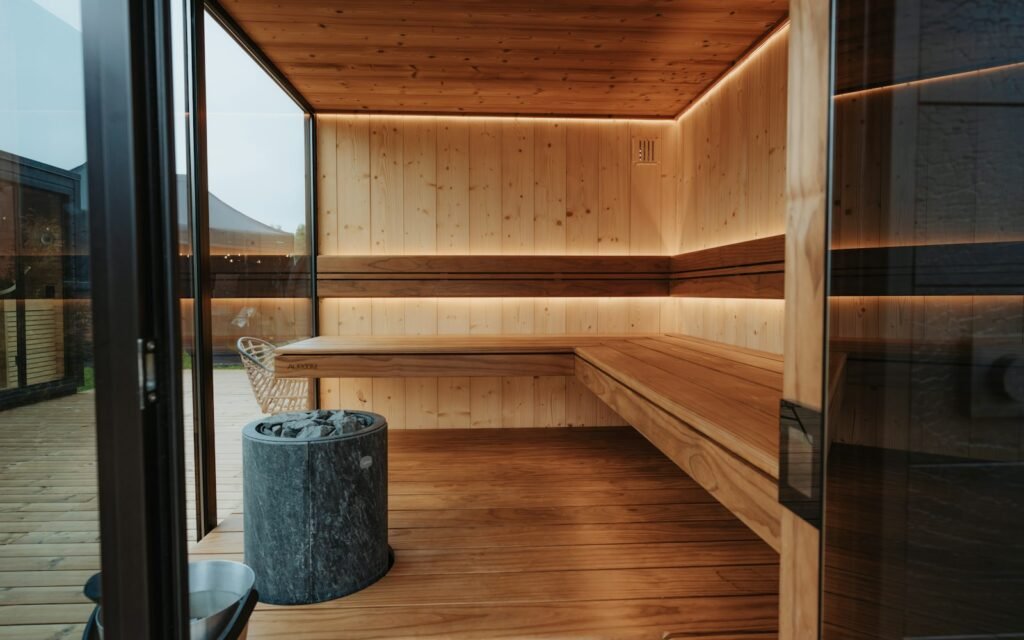
Traditional saunas use an electric (or wood-burning) heater topped with stones. The heater warms the air, and the hot air warms you. When you ladle water onto the stones, it turns into a wave of steam called löyly, which makes the room feel hotter for a minute or two. This is the sauna most people picture from Finland, gyms, and spas.
Infrared saunas use heating panels (usually carbon or ceramic) that give off infrared energy. That energy warms your skin and body directly, the same way you feel warm standing in sunshine on a cold day. The air in the cabin gets warm too, but it doesn’t have to be as hot for you to sweat.
“Full spectrum” infrared saunas add near- and mid-infrared emitters to the usual far-infrared panels. Hybrid saunas combine infrared panels with a small traditional heater, so you can choose either experience in one room. Finnleo’s InfraSauna is one example (Finnleo).
What each one feels like
Traditional: you feel the heat the moment you open the door. Your face and lungs feel it first. A session is often 10 to 15 minutes, followed by a cool-down, then another round. Pouring water on the stones adds intensity, and many people love the ritual.
Infrared: the first few minutes feel mild. After 10 to 15 minutes, a deep, even warmth builds and you start to sweat. Because the air is cooler, many people find it easier to breathe and stay in for 20 to 30 minutes. People who find traditional saunas too intense often prefer infrared.
Which do people stick with? In my experience reading owner forums and reviews, the best sauna is the one you’ll actually use. If you know you dislike intense heat, infrared is more likely to become a daily habit. If you grew up with Finnish-style saunas, infrared may feel too mild.
Installation: space, power, and ventilation
This is where the two differ most, and where your budget is often decided.
Power. Most traditional sauna heaters need a dedicated 240V circuit, often 30 to 50 amps, installed by a licensed electrician. Many 1 to 2-person infrared saunas run on 120V with a dedicated 20-amp circuit; larger ones use 240V. See the full infrared sauna electrical requirements guide.
Ventilation. Traditional saunas need properly placed air intake and exhaust vents so the air stays fresh and heat layers correctly. Infrared cabins have small built-in vents and don’t need a dedicated exhaust fan.
Moisture. Traditional saunas create steam, so the room around them needs to handle moisture. That matters most in basements. Infrared saunas add very little moisture. See the basement sauna planning guide.
Size. Traditional saunas need room for the heater, stones, and a heater guard, plus safety clearances. Infrared saunas can be very compact, which is why they suit closets and small rooms. See one-person saunas for small spaces.
Outdoors. Both can go outside if they’re built for it. Traditional outdoor saunas (including barrel saunas and wood-fired models) are common in cold climates like Minnesota and Canada. Outdoor infrared saunas exist, but many popular infrared brands sell indoor models only. See the outdoor infrared sauna guide.
Cost to buy and install
| Cost item | Infrared | Traditional |
|---|---|---|
| Prefab cabin, 1 to 2 people | About $1,500 to $5,000 | About $3,000 to $6,000 |
| Prefab cabin, 3 to 4 people | About $2,800 to $8,000 | About $4,000 to $8,000 |
| Custom build | Commonly $8,000 to $30,000+ | Commonly $6,000 to $15,000+ |
| Electrical work | $0 to $1,500 | Usually $500 to $1,500 for a 240V circuit |
| Ventilation and moisture prep | Usually minimal | Vents, and moisture protection indoors |
Sources: SaunaPlace, Peak Saunas, and SaunaPlace’s installation guide.
The cabin prices overlap, but traditional saunas almost always add an electrician’s bill, while small infrared saunas sometimes don’t. For a full breakdown of every line item, see how much a home infrared sauna costs.
Cost to run
Running cost follows wattage. Traditional heaters use more power and take longer to warm up, so they cost more to run.
At the US average residential rate of about 18.4 cents per kWh (EIA, May 2026), one analysis estimates that using a sauna three times a week costs roughly $45 to $150 a year for infrared and $180 to $300 a year for a traditional electric sauna (Sun Home Saunas).
In much of Canada, electricity is cheaper, so both cost less to run. Quebec and Manitoba, with low-cost hydro power, have some of the lowest rates in the country (Canada Energy Regulator).
Either way, running costs are small next to the purchase price.
Health benefits: what the research does and doesn’t say
Both types make you sweat, raise your heart rate, and raise your body temperature, which is where most of the benefits people talk about come from.
- The best-known long-term research is on traditional saunas. A Finnish study that followed 2,315 men for 20 years linked frequent sauna use with lower cardiovascular mortality. It was observational, not a controlled trial, and it studied traditional Finnish saunas.
- Infrared-specific research is growing but smaller. Most studies are short and involve small groups, covering areas like muscle recovery, pain, and relaxation.
- Traditional saunas raise core temperature more quickly. Infrared’s advantage is that the lower air temperature makes longer, more comfortable sessions possible.
Sauna use isn’t medical treatment. If you’re pregnant, have a heart condition, low or high blood pressure, or take medication that affects how your body handles heat, talk to your doctor first. Don’t use any sauna after drinking alcohol.
Which should you choose?
Choose infrared if:
- You want a gentler heat you can sit in for 20 to 30 minutes
- You plan to use it most days and want it ready in 10 to 20 minutes
- You have a small space, a closet, or a basement corner
- You want the simplest electrical setup, possibly 120V
- You’re interested in adding red light therapy (see infrared saunas with red light therapy)
Choose traditional if:
- You love intense heat and steam from water on the stones
- You want a social sauna for family and friends, with cool-down rounds
- You’re building outdoors in a cold climate and want a classic sauna cabin
- You already have, or are happy to add, a 240V circuit and proper ventilation
Can’t decide? Look at a hybrid sauna that offers both, or try each at a local gym or spa before you buy.
If you’re leaning toward infrared and your space is awkward, a custom build may be the best fit. SaunaCloud designs far-infrared saunas to your room’s exact size and sends free 3D renderings and a proposal in 24 to 48 hours. Compare options in custom vs prefab infrared saunas.
Frequently asked questions
Is an infrared sauna as good as a traditional sauna? They’re different, not better or worse. Traditional saunas get hotter and offer steam. Infrared saunas heat you at lower air temperatures, which many people find more comfortable for longer sessions.
Which is cheaper, infrared or traditional? Infrared is usually cheaper to install and run, mainly because smaller models can use 120V power and the heaters draw less electricity.
Can you pour water on an infrared sauna? No. Infrared panels aren’t designed for water. If you want steam, you need a traditional sauna or a hybrid with a stone heater.
Which heats up faster? Infrared saunas are usually ready in about 10 to 20 minutes. Traditional saunas often take 20 to 45 minutes, depending on heater size and power.
Do traditional saunas need a 240V circuit? Almost always. Most traditional sauna heaters need a dedicated 240V circuit installed by a licensed electrician.
Which is better for a basement? Infrared is usually easier, because it doesn’t create steam and needs less ventilation. A traditional sauna can work in a basement with proper vents and moisture protection.