This guide contains affiliate links. If you buy through them, I may earn a commission at no extra cost to you. Learn more
In this guide
- Red light therapy vs infrared heat: they’re not the same thing
- How red light is added to a sauna
- What red light therapy may do, and what to be careful about
- What an infrared sauna with red light costs
- Electrical and installation notes
- Questions to ask before you buy
- A simple routine for heat and red light
- Is red light worth paying extra for?
- Frequently asked questions
An infrared sauna with red light therapy combines two things in one session: infrared heat that warms your body, and LED red and near-infrared light at specific wavelengths (often around 660 nm and 850 nm) aimed at your skin. Expect to pay roughly $3,000 to $10,000 for a prefab cabin with built-in red light, or more for a custom build. The detail that matters most is how close the LEDs sit to your body, because light weakens quickly with distance.
Red light has become one of the most popular sauna features in the US and Canada. It’s also one of the most confusing. This guide explains what’s actually going on, what it costs, and the questions to ask before you pay extra for it.
Red light therapy vs infrared heat: they’re not the same thing
This is the most common mix-up, and sauna marketing doesn’t always help.
Infrared heaters (carbon, ceramic, or “full spectrum” halogen emitters) are designed to make heat. Far-infrared heaters warm your body; full-spectrum saunas add near- and mid-infrared emitters that also produce heat and light.
Red light therapy, also called photobiomodulation, uses LEDs that emit light at narrow, specific wavelengths. They’re designed to deliver light energy to your skin, not to heat the room. The common wavelengths are:
- Red light: about 630 to 670 nm (visible as a deep red glow)
- Near-infrared light: about 810 to 850 nm (mostly invisible)
So a “full-spectrum” sauna isn’t automatically a red light therapy sauna, and a red light panel doesn’t heat a sauna. Many saunas now include both: infrared heaters for warmth, plus a separate LED red light system with its own controls.
How red light is added to a sauna
There are three common setups:
1. A wall-mounted or freestanding panel. An LED panel is mounted on a wall or placed on a stand inside the sauna. It’s the most common approach in prefab cabins. Health Mate’s Inspire, for example, includes a 96-diode red light panel (Sun Home Saunas comparison).
2. A tower or add-on unit. Some brands sell a red light tower that sits inside or beside the sauna as an upgrade.
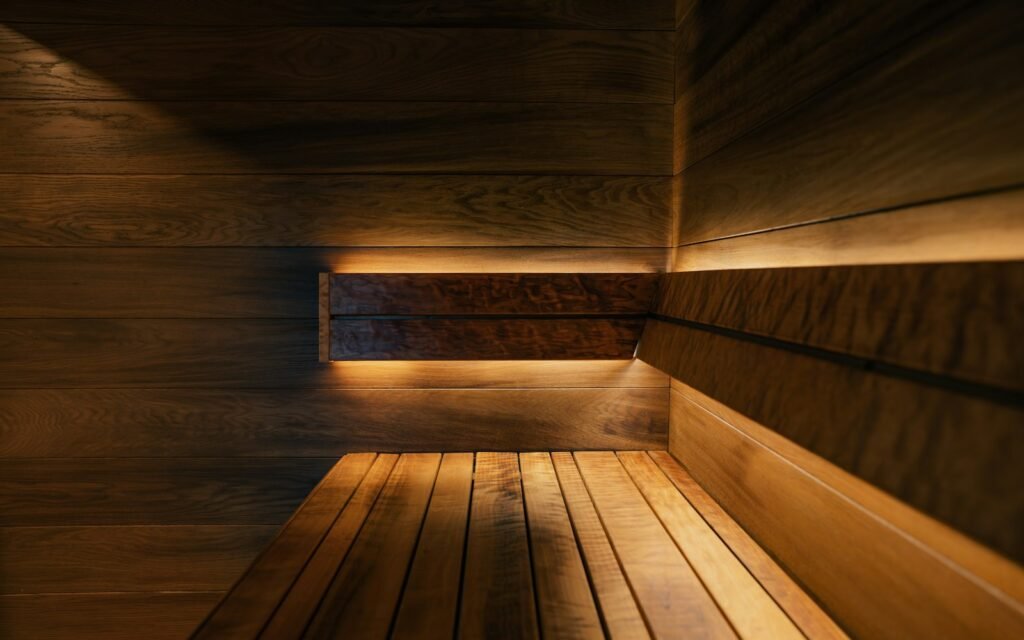
3. Bench-integrated LEDs. The LEDs are built into the bench, between the wood slats, close to your skin. SaunaCloud uses this approach, with nominal 660 nm red and 850 nm near-infrared LEDs, and lets you run heat, red light, or both from the same Wi-Fi controls.
Why placement matters. Light intensity drops off quickly as distance increases. A panel across the cabin delivers much less light to your body than one a few inches away. When you compare saunas, ask where the LEDs are, how far they’ll be from your body when you sit normally, and which parts of your body they’ll reach.
What red light therapy may do, and what to be careful about
Red light therapy is an active area of research, especially for skin, muscle recovery, and some kinds of pain. Many studies are small, use different wavelengths and doses, and use dedicated devices rather than saunas. So it’s fair to say red light is promising for some uses, but it’s not proven for every claim you’ll see in ads.
Things to keep in mind:
- Dose matters. Results in studies depend on wavelength, intensity, distance, and time. Few sauna makers publish irradiance figures, so it’s hard to compare one sauna’s red light with another’s.
- Protect your eyes. Don’t stare into bright LEDs. Some manufacturers supply eye protection.
- Check medications. Some medications make skin more sensitive to light. Ask your doctor or pharmacist if you’re unsure.
- Health conditions. If you’re pregnant, have a heart condition, or have a medical condition affected by heat, talk to your doctor before using any sauna.
A sauna with red light is a wellness product, not a medical treatment. Be wary of any company promising specific medical results.
What an infrared sauna with red light costs
| Option | Typical price (USD) | Notes |
|---|---|---|
| Add-on red light panel for an existing sauna | Several hundred to a few thousand dollars | Check it’s rated for sauna heat |
| Prefab 1 to 2-person infrared sauna with red light | About $3,000 to $8,000 | Panel or tower, usually on one wall |
| Premium prefab with full spectrum plus red light | About $6,000 to $10,000+ | More heaters, more features |
| Custom infrared sauna with integrated red light | About $8,000 to $30,000+ | LEDs placed for your bench layout |
Example published prices include the Dynamic Santiago FS at about $3,299 and the Health Mate Inspire at about $5,000 to $6,000 (Sun Home Saunas comparison). SaunaCloud says most of its custom home saunas sold from November 2025 to October 2026 landed between $11,000 and $24,000 before shipping and tax.
Running cost: LED red light systems use much less power than heaters. The heaters still drive your electric bill. See how much a home infrared sauna costs for the full breakdown.
Electrical and installation notes
Red light usually doesn’t change your electrical plan much, because the LEDs draw far less power than the heaters. Your sauna’s overall requirement (120V or 240V, and the amps) still comes from the heaters. Check the manual, and see the electrical requirements guide.
A few practical points:
- Separate controls are useful. Being able to run red light without heat (or heat without red light) gives you more flexibility.
- Heat-rated components. LEDs and drivers inside a sauna must be rated for the heat. Ask the manufacturer.
- Warranty. Red light systems often have shorter warranties than heaters. SaunaCloud, for example, covers residential heaters for 7 years but its red light system for 1 year (for agreements signed from October 30, 2026).
Questions to ask before you buy
- What wavelengths do the LEDs use? Look for published numbers, such as 660 nm and 850 nm.
- Where are the LEDs, and how far will they be from my body? Ask for a drawing.
- Which parts of my body will the light reach when I sit normally?
- Can I run red light and heat separately?
- Do you publish irradiance (light intensity) at a given distance?
- What’s the warranty on the red light system specifically?
- Is it a built-in feature or an add-on, and can it be replaced if it fails?
- Does the red light affect the sauna’s EMF readings? Ask for whole-sauna test results.
A simple routine for heat and red light
How you combine heat and red light is up to you and your manufacturer’s guidance, but many owners follow a pattern like this:
- Preheat the sauna for 10 to 20 minutes.
- Drink a glass of water before you go in.
- Start with red light and heat together for 10 to 15 minutes, sitting so the LEDs face the area you want to target.
- Continue with heat only for another 5 to 15 minutes if you’re comfortable.
- Cool down slowly, then shower and rehydrate.
If you’re new to saunas, start with shorter sessions and build up over a couple of weeks. With bench-integrated LEDs, your posture decides what the light reaches, so experiment with sitting upright, leaning back, or lying down if your bench allows it.
Is red light worth paying extra for?
It’s worth considering if:
- You were going to buy a separate red light panel anyway
- You like the idea of one daily routine instead of two
- The LEDs are placed close to your body, with published wavelengths
It may not be worth it if:
- The only red light is a small panel across the cabin
- It adds a lot to the price with no published specifications
- You mainly want heat, and would rather spend the money on a bigger sauna or better heaters
If you want red light built in close to your body, a custom sauna lets you decide exactly where it goes. SaunaCloud designs far-infrared saunas with bench-integrated red light and sends free 3D renderings and a proposal in 24 to 48 hours. Read what to know before you request a SaunaCloud design, or compare options in custom infrared sauna companies compared.
Still deciding between heat types? See infrared vs traditional saunas.
Frequently asked questions
Is red light therapy the same as an infrared sauna? No. Infrared saunas use heaters to warm your body. Red light therapy uses LEDs at specific red and near-infrared wavelengths to deliver light to your skin. Some saunas include both.
What wavelength is best for red light therapy in a sauna? Many systems use red light around 630 to 670 nm and near-infrared around 810 to 850 nm. SaunaCloud, for example, uses nominal 660 nm and 850 nm LEDs.
Can I add red light to my existing sauna? Often, yes, with a panel or tower made for sauna use. Check that it’s rated for the heat and that it won’t void your sauna’s warranty.
Does red light make a sauna hotter? Not noticeably. LEDs produce far less heat than infrared heaters.
How much does an infrared sauna with red light cost? Prefab models with red light commonly run about $3,000 to $10,000. Custom builds with integrated red light usually start around $8,000 and can exceed $20,000.
Is red light therapy safe? It’s generally considered low risk for healthy adults when used as directed. Protect your eyes, check whether any medications make you light-sensitive, and ask your doctor if you have a medical condition.